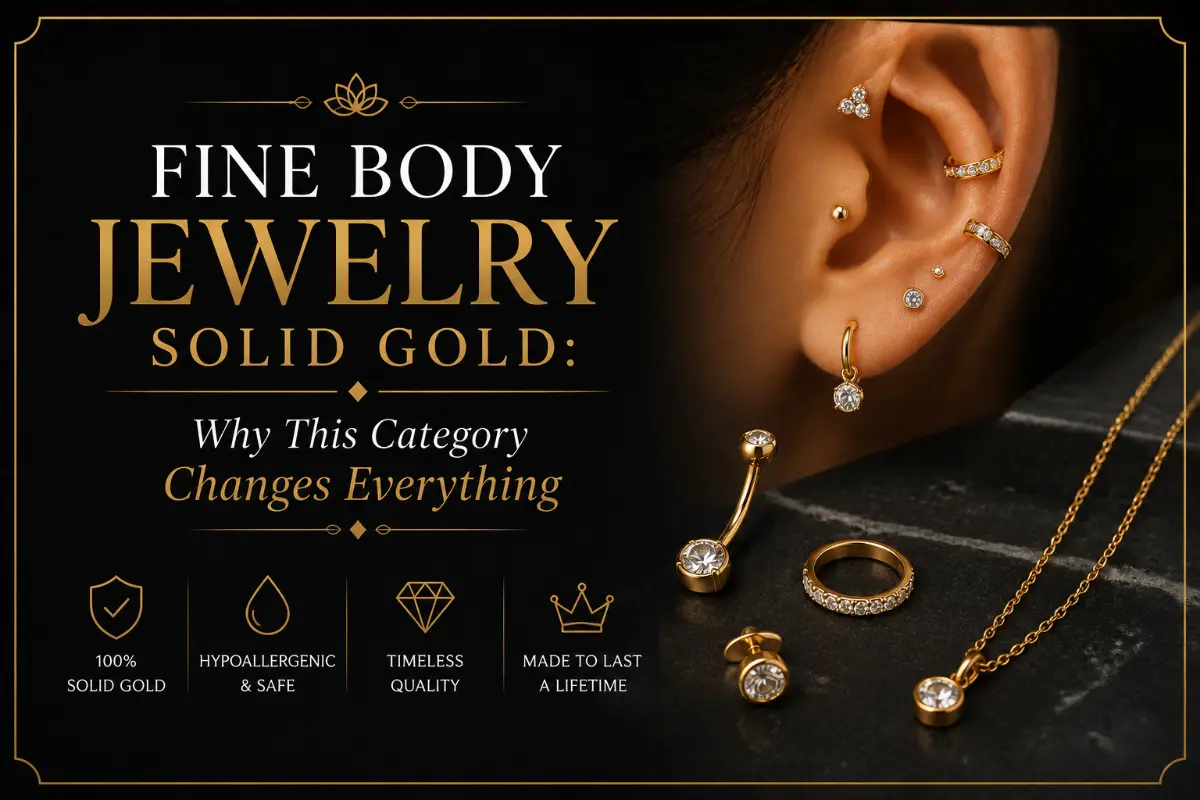
Fine body jewelry solid gold is not a niche corner of the jewelry market anymore. In 2026, it is one of the fastest-growing categories in fine jewelry, and Human Design Studios is one of the very few fine jewelry brands with a dedicated, curated body jewelry collection to meet the demand.
Most people who come to us for body jewelry have had the same experience. They bought a plated nose ring. It looked great in the shop, then turned green in two weeks and left a rash. They switched to surgical steel. Better, but cold-looking and not quite fine jewelry. Then they found solid 14k gold body jewelry and something shifted.
This guide covers everything you need to know about fine body jewelry in solid gold: what makes it truly fine, how implant-grade gold differs from plated, how threadless and push-pin styles work, nose ring sizing, navel ring sizing, and how to choose the right piece for a healing versus a healed piercing.
If you are ready to shop right now, our full Body Jewelry Collection is available in solid 14k gold across yellow, white, and rose gold options.
Fine body jewelry means jewelry made from genuine precious metals and gemstones, crafted to the same quality standards as any fine ring, necklace, or earring, but sized, shaped, and constructed specifically for body piercings.
The word “fine” carries real weight here. It is not a marketing term. Fine body jewelry means:
Solid precious metal construction throughout, including the post, the backing, and the decorative end
Nickel-free alloys that are biocompatible with skin tissue
Precision-polished surfaces with no rough edges or pits that could harbor bacteria
Proper gauge tolerances that match professional piercing standards
Stones that are set securely enough to withstand daily wear in active piercing sites
What fine body jewelry is not: gold-plated over base metal, gold-filled, or gold vermeil. All three of these share the same critical flaw for body jewelry: the outer gold layer wears away through friction, body oils, sweat, and moisture, exposing the base metal beneath. In a piercing site, that base metal exposure can cause allergic reactions, irritation bumps, and contact dermatitis.
For everyday jewelry worn on your wrist or around your neck, gold-filled might be acceptable for a while. For jewelry inside an active piercing site where metal contacts living tissue continuously, only solid gold or implant-grade materials belong.
Browse our Essentials Collection for everyday fine jewelry across all categories, or go directly to our Body Jewelry Collection for pieces built specifically for piercing sites.
Implant-Grade Gold vs Plated Gold: The Difference That Matters
This is the single most important distinction in body jewelry. It separates fine body jewelry from fashion body jewelry, and it explains why two nose rings that look identical in a photograph produce completely different experiences inside a piercing.
Implant-grade gold refers to solid 14k or 18k gold made with a nickel-free alloy. The term comes from the same material standards used for surgical and medical implants, meaning the metal has been verified as biocompatible for long-term contact with human tissue.
Solid 14k gold in a palladium-based or nickel-free alloy is the gold standard for healed piercings. It does not oxidize, rust, or corrode. It does not leach metal ions into the skin. It handles shower, sweat, body oils, skincare products, and daily movement without degrading. A solid 14k gold nose ring worn every day looks the same in year three as it did in week one.
Gold-plated jewelry applies a thin layer of gold over a base metal core, typically brass, copper, or stainless steel. The plating is measured in microns. Standard fashion jewelry plating runs 0.5 to 2.5 microns thick. At that thickness, the gold layer begins wearing through at friction points within weeks to months in active piercing sites. What is underneath that layer is typically nickel-containing metal, which is the most common cause of metal allergy and contact dermatitis from jewelry.
Gold vermeil is better than standard plating, but the same principle applies. It is still plated over sterling silver, and even with a thicker gold layer, it degrades in the friction environment of a daily-worn piercing.
The chart below makes the material hierarchy clear:
Material
Core
Gold Content
Degrades in Piercings
Biocompatible
Solid 14k Gold (nickel-free)
Pure gold alloy
58.3% solid
No
Yes
Solid 18k Gold (nickel-free)
Pure gold alloy
75% solid
No
Yes
Gold Vermeil
Sterling silver
Surface only
Yes (months to years)
Partially
Gold-Filled
Brass
Surface only
Yes (months)
No
Gold-Plated
Brass or copper
Surface only
Yes (weeks to months)
No
Every piece in the Human Design Studios Body Jewelry Collection is solid 14k gold in yellow, white, or rose gold. There are no plated options in our body jewelry range, because there should not be.
For guidance on caring for your fine body jewelry over time, visit our Care Guide.
Threadless vs Push-Pin Body Jewelry: A Clear Explanation
If you have ever been confused by the terms threadless, push-pin, press-fit, internally threaded, and externally threaded, you are not alone. Here is a clear breakdown of what each term actually means, and which is right for your piercing.
Externally Threaded Jewelry
Externally threaded jewelry has the screw threads on the outside of the post itself. When you insert this jewelry into a piercing, those threads scrape the inside of the piercing channel on the way in. This is the cheapest construction method and the one that causes the most irritation in healing or cartilage piercings. Reputable professional piercers do not use externally threaded jewelry in new piercings, and the Association of Professional Piercers (APP) advises against it for healing piercings entirely.
If you unscrew the top of a piece of jewelry and see threads on the shaft of the post, it is externally threaded. Avoid it for any healing piercing.
Internally Threaded Jewelry
Internally threaded jewelry has the threads on the inside of the decorative end or ball, not on the post. The post is smooth on the outside. When you insert internally threaded jewelry, the smooth post slides cleanly through the piercing channel without scraping tissue. This is the correct construction standard for threaded fine body jewelry. It is more expensive to manufacture, which is why cheaper jewelry skips it, but for a healing piercing it is significantly better for the tissue.
Threadless (Push-Pin) Jewelry
Threadless jewelry, also called push-pin jewelry or press-fit jewelry, uses no threads at all. It works on tension. The decorative end has a thin pin that is pre-bent at a slight angle. When you press that pin into the hollow post, the bent pin creates spring-like tension against the interior walls of the post, holding the two pieces together securely without screwing.
The result is a jewelry piece with a completely smooth exterior, no threads to check or tighten, and the ability to swap decorative ends onto the same post. Because the post is universal across threadless designs, one solid gold threadless post can accept dozens of different decorative tops: a simple gold ball, a bezel-set moissanite, a star charm, a birthstone, or a pearl drop.
Our Threadless Collection showcases this versatility. One post, unlimited styling possibilities.
Which style should you choose?
Situation
Best Choice
Fresh or healing piercing
Internally threaded or threadless (both have smooth posts)
Healed piercing, rarely changed
Internally threaded solid gold
Healed piercing, frequent style changes
Threadless push-pin
Ear curations and cartilage styling
Threadless (universal post system)
Avoid entirely for healing piercings
Externally threaded
For a curated ear with multiple cartilage piercings, threadless is the practical winner. One quality post at each piercing point, and the decorative tops become a collection you rotate seasonally. Browse our Huggie Hoops Collection for complementary ear pieces designed to sit alongside threadless cartilage studs.
Nose Ring Size Guide: Gauge, Post Length, and Hoop Diameter
Nose ring sizing confuses almost every first-time buyer because it involves three separate measurements: gauge (the thickness of the post), post length (how long the shaft is), and hoop diameter (for hoops only, the internal width of the ring).
Nose Ring Gauge Guide
The gauge system in body jewelry works inversely to what you expect: the higher the gauge number, the thinner the jewelry.
Gauge
Diameter
Best For
22G
0.6mm
Very delicate, subtle nostril studs on healed piercings
20G
0.8mm
Most popular for healed nostril piercings, subtle and comfortable
18G
1.0mm
Industry standard for new nostril piercings, slightly more durable
16G
1.2mm
Septum piercings and some high nostril placements
14G
1.6mm
Navel piercings, some septum styles
For most nostril piercings, your starting gauge is 18G or 20G. Your piercer will have told you which they used when they performed the piercing, and matching that gauge when you buy new jewelry is essential. Going smaller than your original gauge causes the piercing to gradually shrink; going larger forces a stretch.
When in doubt, 20G fits the majority of healed nostril piercings comfortably.
Nose Ring Post Length
Standard post lengths for nostril studs run between 6mm and 8mm. If you have thinner nose tissue, 6mm is typically the right fit. For thicker tissue or a placement with more depth, 7mm to 8mm prevents the backing from pressing too tightly against the inside of the nostril.
Nose Hoop Diameter
For nostril hoops, the most common internal diameters are 8mm and 10mm. Anatomy varies, so if you are unsure, your piercer can measure this for you with a simple tool.
Navel Ring Guide: Gauge, Length, and Style Selection
Navel piercings use a curved barbell, and the sizing terminology differs slightly from nose rings.
Navel Ring Gauge
Standard navel piercings are performed at 14G (1.6mm), which is thicker than nose piercings. Some piercers use 16G for finer-gauge navel work, but 14G is the professional standard for healing navel piercings because the navel is a high-movement, high-friction site. A thicker gauge gives the piercing more structural integrity as it heals.
Navel Barbell Length
Standard curved barbells for navel piercings are 10mm to 12mm in length, measured along the interior curve. For initial healing, a longer 14mm barbell is sometimes used to accommodate swelling. Once the piercing is healed, a standard 10mm barbell sits more neatly and moves less.
Healing vs Healed Navel Piercings
Navel piercings have one of the longer healing timelines in body piercing: typically 6 to 12 months for full healing, and sometimes longer depending on lifestyle factors. During healing:
Stay with the original jewelry placed by your piercer, which should be implant-grade titanium or solid gold
Avoid changing jewelry until a professional piercer confirms the piercing is fully healed
Avoid tight waistbands, high-rise jeans, and clothing that creates constant friction at the piercing site
Clean with saline spray twice daily
Once healed, a navel piercing accepts solid 14k gold curved barbells beautifully, and this is when the real styling begins. Our Body Jewelry Collection includes curved barbells designed for healed navel piercings in solid 14k gold with gemstone top options.
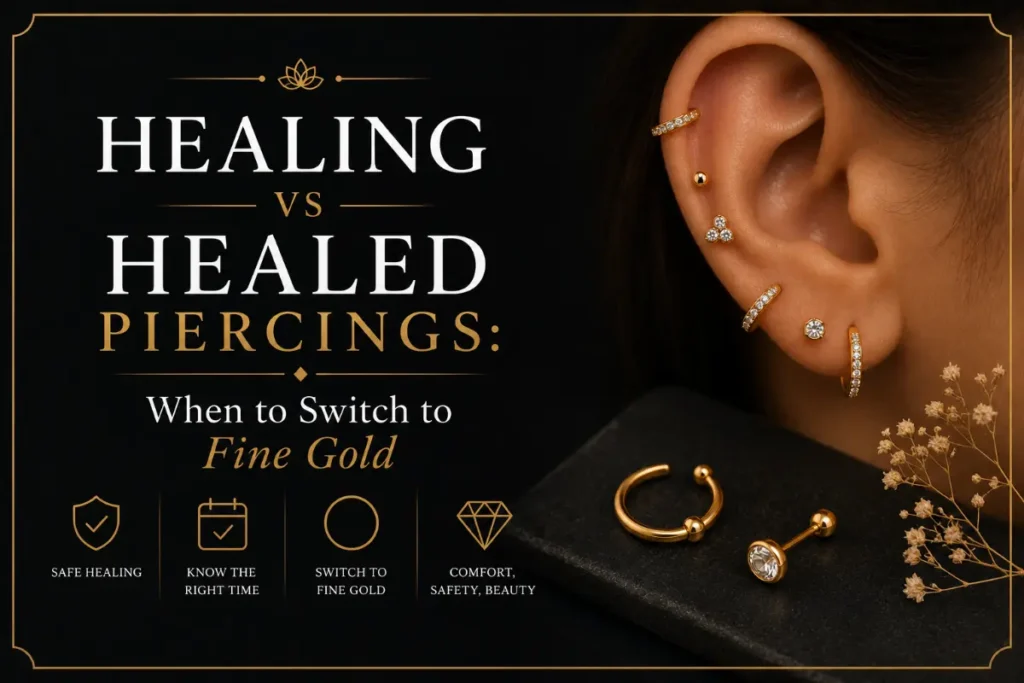
Healing vs Healed Piercings: When to Switch to Fine Gold
This is the question our studio gets most often: when can I switch to solid gold?
The honest answer is: when your piercing is fully healed, not just when it stops hurting.
Pain going away and a piercing being healed are two different timelines. A nostril piercing may stop being sore within four to eight weeks, but the internal fistula (the channel of skin that lines the piercing) can take three to six months to fully mature. A cartilage piercing like a helix or conch can take nine to eighteen months.
For fresh and healing piercings, implant-grade titanium (ASTM F-136) is generally the first-choice material among professional piercers because it is extremely lightweight, completely inert, and available in anodized colors. Solid 14k gold is also acceptable for healing piercings if it is nickel-free and properly polished.
Once fully healed, solid 14k gold in fine body jewelry is the best long-term material for daily wear. It is heavier than titanium (which some people love, others find takes adjustment), completely biocompatible for life, and ages beautifully without any surface treatment.
The rule is straightforward: do not rush the switch. Let the piercing heal completely, confirm with a professional piercer, then invest in fine gold body jewelry designed to last a lifetime.
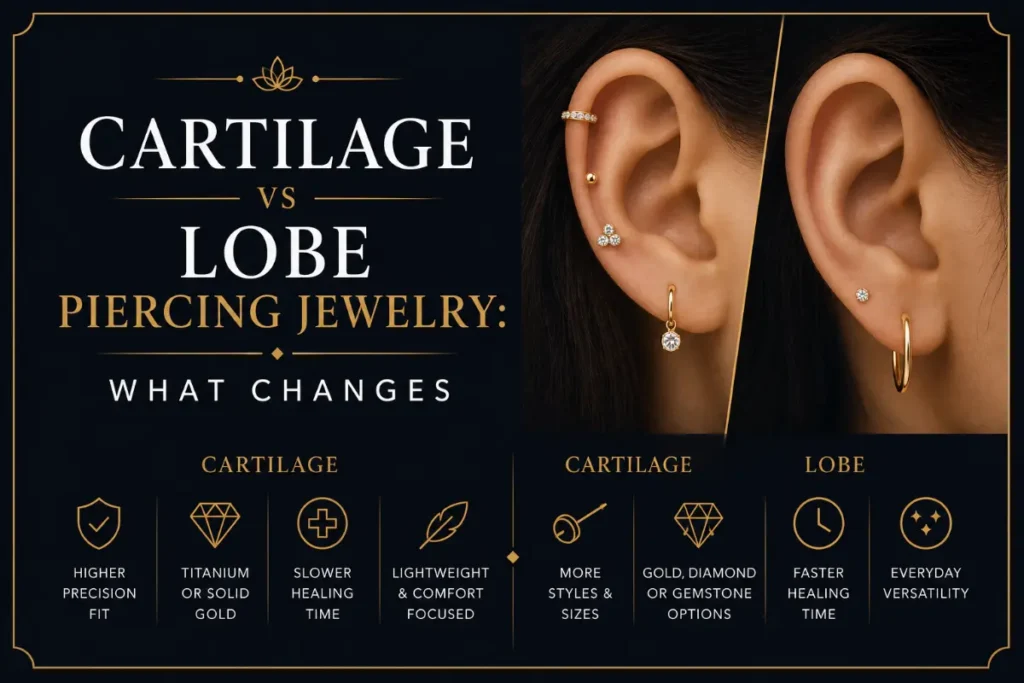
Cartilage vs Lobe Piercing Jewelry: What Changes
Cartilage piercings (helix, tragus, conch, rook, daith, forward helix) and lobe piercings both accept fine body jewelry, but the jewelry specifications differ in a few important ways.
Gauge: Lobe piercings typically use 20G or 18G. Cartilage piercings often use 16G because cartilage tissue needs a slightly thicker gauge for structural support during the longer healing period.
Backing style: For cartilage, flat-back labret studs (threadless or internally threaded) are the most comfortable long-term option because the flat disc on the back does not dig into the inner ear during sleep or when wearing headphones. Standard butterfly backs or screw balls can become uncomfortable in cartilage positions over time.
Post length: Cartilage sites often require slightly longer posts than lobe piercings to clear the thickness of the ear at the specific placement point.
Healing time: Lobe piercings generally heal in six to eight weeks. Cartilage piercings take nine to eighteen months. This longer healing window makes the quality of the initial jewelry even more important in cartilage placements.
Most fine jewelry brands do not carry body jewelry at all. The few that do typically stock one or two token pieces as an afterthought. Human Design Studios built a dedicated body jewelry category because we believe fine jewelry should not stop at the earlobes.
Our Body Jewelry Collection is crafted in solid 14k gold in yellow, white, and rose options, with the same artisan standards applied to every other category in our studio. Every piece is nickel-free. Every post is smooth-surfaced. Every stone setting is secured to withstand the active, friction-heavy environment that body piercing jewelry operates in.
This extends across our broader collections too. Our Threadless Collection offers the swappable push-pin system ideal for ear curation and cartilage styling. Our One of a Kind Collection occasionally includes singular body jewelry pieces for clients who want something truly unique.
For clients who want a specific stone, a custom gauge, or a personalised design built around an existing piercing layout, our Custom Design and Custom Experience services handle body jewelry commissions alongside all other custom pieces.
Human Design Studios serves clients in New York City, Oahu Hawaii, Nashville and Franklin Tennessee. If you are near any of our pop-up locations, our Stockists page has current event dates where you can see body jewelry pieces in person before purchasing.
FAQ: Fine Body Jewelry Solid Gold
What makes body jewelry “fine”? Fine body jewelry is made from solid precious metals (typically 14k or 18k gold) throughout the entire piece, including the post and the backing. It uses nickel-free alloys, precision-polished surfaces, and secure stone settings. It is manufactured to the same quality standards as fine rings and necklaces, not as a fashion accessory.
Is solid 14k gold safe for a healing piercing? Yes, provided the gold is nickel-free. Solid 14k gold in a palladium-based, nickel-free alloy is biocompatible and safe for healing piercings. Many professional piercers use and recommend solid gold for initial jewellery placements. The key is nickel-free. Gold alloys that contain nickel can cause allergic contact dermatitis in sensitive individuals.
What is the difference between threadless and push-pin jewelry? They are the same thing. Threadless jewelry and push-pin jewelry both describe a system where a decorative end with a slightly bent pin is pressed into a hollow post, creating tension-based security with no threads. The terms are interchangeable in the body jewelry industry.
What gauge nose ring do I need? Most nostril piercings are performed at 18G (1.0mm) or 20G (0.8mm). Check with the piercer who performed your piercing to confirm your specific gauge. If you are buying a nose ring without knowing your gauge, 20G fits the majority of healed nostril piercings.
What gauge is a navel ring? Standard navel piercings use 14G (1.6mm). The standard curved barbell length for a healed navel piercing is 10mm. For initial healing, a slightly longer 12mm to 14mm barbell is sometimes used to accommodate swelling.
Can I wear fine gold body jewelry in a cartilage piercing? Yes. Solid 14k gold flat-back labret studs are an excellent choice for healed cartilage piercings including helix, tragus, conch, rook, and daith. Cartilage piercings typically use 16G jewelry, which is slightly thicker than nose piercings. Confirm your gauge with your piercer before purchasing.
Does Human Design Studios offer body jewelry in rose and white gold? Yes. Our Body Jewelry Collection is available in solid 14k yellow, white, and rose gold. Rose gold body jewelry has become particularly popular in 2026 for nostril and cartilage placements.
How do I care for solid gold body jewelry? Clean with a saline solution or mild soap and warm water. Avoid harsh chemicals, alcohol-based cleaners, and ultrasonic cleaners for body jewelry with set stones. Our full Care Guide covers maintenance for all Human Design Studios fine jewelry including body pieces.
Can I get custom body jewelry made? Yes. Our Custom Design service accepts body jewelry commissions for specific gauges, stone types, post lengths, and design preferences.
Where can I view Human Design Studios body jewelry in person? Check our Stockists page for current pop-up locations in New York, Hawaii, and Nashville and Franklin Tennessee. Contact us through our Contact page for more information.
The Bottom Line: Fine Body Jewelry Solid Gold in 2026
Body jewelry has graduated from the accessories aisle. In 2026, it belongs in the same category as fine rings and fine necklaces, held to the same material standards, the same craftsmanship standards, and the same expectation of longevity.
The decision between plated body jewelry and fine body jewelry solid gold comes down to a simple question: do you want a piece that lasts two months or a piece that lasts twenty years?
At Human Design Studios, the answer has always been the same. Every piece we make, including every body jewelry piece, is built to be worn daily, to withstand real life, and to look exactly the same a decade from now as the day it arrived.
Human Design Studios Fine Jewelry serves clients in New York City, Oahu Hawaii, Nashville and Franklin Tennessee, and ships worldwide. All body jewelry pieces are crafted in solid 14k gold and covered under our Repairs and Warranty programme. Visit our Blog for more fine jewelry guides, or review our FAQ page and Shipping and Exchanges policy for ordering details.
Fine Body Jewelry Solid Gold: Why This Category Changes Everything
Fine body jewelry solid gold is not a niche corner of the jewelry market anymore. In 2026, it is one of the fastest-growing categories in fine jewelry, and Human Design Studios is one of the very few fine jewelry brands with a dedicated, curated body jewelry collection to meet the demand.
Most people who come to us for body jewelry have had the same experience. They bought a plated nose ring. It looked great in the shop, then turned green in two weeks and left a rash. They switched to surgical steel. Better, but cold-looking and not quite fine jewelry. Then they found solid 14k gold body jewelry and something shifted.
This guide covers everything you need to know about fine body jewelry in solid gold: what makes it truly fine, how implant-grade gold differs from plated, how threadless and push-pin styles work, nose ring sizing, navel ring sizing, and how to choose the right piece for a healing versus a healed piercing.
If you are ready to shop right now, our full Body Jewelry Collection is available in solid 14k gold across yellow, white, and rose gold options.
What Is Fine Body Jewelry?
Fine body jewelry means jewelry made from genuine precious metals and gemstones, crafted to the same quality standards as any fine ring, necklace, or earring, but sized, shaped, and constructed specifically for body piercings.
The word “fine” carries real weight here. It is not a marketing term. Fine body jewelry means:
Solid precious metal construction throughout, including the post, the backing, and the decorative end
Nickel-free alloys that are biocompatible with skin tissue
Precision-polished surfaces with no rough edges or pits that could harbor bacteria
Proper gauge tolerances that match professional piercing standards
Stones that are set securely enough to withstand daily wear in active piercing sites
What fine body jewelry is not: gold-plated over base metal, gold-filled, or gold vermeil. All three of these share the same critical flaw for body jewelry: the outer gold layer wears away through friction, body oils, sweat, and moisture, exposing the base metal beneath. In a piercing site, that base metal exposure can cause allergic reactions, irritation bumps, and contact dermatitis.
For everyday jewelry worn on your wrist or around your neck, gold-filled might be acceptable for a while. For jewelry inside an active piercing site where metal contacts living tissue continuously, only solid gold or implant-grade materials belong.
Browse our Essentials Collection for everyday fine jewelry across all categories, or go directly to our Body Jewelry Collection for pieces built specifically for piercing sites.
Implant-Grade Gold vs Plated Gold: The Difference That Matters
This is the single most important distinction in body jewelry. It separates fine body jewelry from fashion body jewelry, and it explains why two nose rings that look identical in a photograph produce completely different experiences inside a piercing.
Implant-grade gold refers to solid 14k or 18k gold made with a nickel-free alloy. The term comes from the same material standards used for surgical and medical implants, meaning the metal has been verified as biocompatible for long-term contact with human tissue.
Solid 14k gold in a palladium-based or nickel-free alloy is the gold standard for healed piercings. It does not oxidize, rust, or corrode. It does not leach metal ions into the skin. It handles shower, sweat, body oils, skincare products, and daily movement without degrading. A solid 14k gold nose ring worn every day looks the same in year three as it did in week one.
Gold-plated jewelry applies a thin layer of gold over a base metal core, typically brass, copper, or stainless steel. The plating is measured in microns. Standard fashion jewelry plating runs 0.5 to 2.5 microns thick. At that thickness, the gold layer begins wearing through at friction points within weeks to months in active piercing sites. What is underneath that layer is typically nickel-containing metal, which is the most common cause of metal allergy and contact dermatitis from jewelry.
Gold vermeil is better than standard plating, but the same principle applies. It is still plated over sterling silver, and even with a thicker gold layer, it degrades in the friction environment of a daily-worn piercing.
The chart below makes the material hierarchy clear:
Material
Core
Gold Content
Degrades in Piercings
Biocompatible
Solid 14k Gold (nickel-free)
Pure gold alloy
58.3% solid
No
Yes
Solid 18k Gold (nickel-free)
Pure gold alloy
75% solid
No
Yes
Gold Vermeil
Sterling silver
Surface only
Yes (months to years)
Partially
Gold-Filled
Brass
Surface only
Yes (months)
No
Gold-Plated
Brass or copper
Surface only
Yes (weeks to months)
No
Every piece in the Human Design Studios Body Jewelry Collection is solid 14k gold in yellow, white, or rose gold. There are no plated options in our body jewelry range, because there should not be.
For guidance on caring for your fine body jewelry over time, visit our Care Guide.
Threadless vs Push-Pin Body Jewelry: A Clear Explanation
If you have ever been confused by the terms threadless, push-pin, press-fit, internally threaded, and externally threaded, you are not alone. Here is a clear breakdown of what each term actually means, and which is right for your piercing.
Externally Threaded Jewelry
Externally threaded jewelry has the screw threads on the outside of the post itself. When you insert this jewelry into a piercing, those threads scrape the inside of the piercing channel on the way in. This is the cheapest construction method and the one that causes the most irritation in healing or cartilage piercings. Reputable professional piercers do not use externally threaded jewelry in new piercings, and the Association of Professional Piercers (APP) advises against it for healing piercings entirely.
If you unscrew the top of a piece of jewelry and see threads on the shaft of the post, it is externally threaded. Avoid it for any healing piercing.
Internally Threaded Jewelry
Internally threaded jewelry has the threads on the inside of the decorative end or ball, not on the post. The post is smooth on the outside. When you insert internally threaded jewelry, the smooth post slides cleanly through the piercing channel without scraping tissue. This is the correct construction standard for threaded fine body jewelry. It is more expensive to manufacture, which is why cheaper jewelry skips it, but for a healing piercing it is significantly better for the tissue.
Threadless (Push-Pin) Jewelry
Threadless jewelry, also called push-pin jewelry or press-fit jewelry, uses no threads at all. It works on tension. The decorative end has a thin pin that is pre-bent at a slight angle. When you press that pin into the hollow post, the bent pin creates spring-like tension against the interior walls of the post, holding the two pieces together securely without screwing.
The result is a jewelry piece with a completely smooth exterior, no threads to check or tighten, and the ability to swap decorative ends onto the same post. Because the post is universal across threadless designs, one solid gold threadless post can accept dozens of different decorative tops: a simple gold ball, a bezel-set moissanite, a star charm, a birthstone, or a pearl drop.
Our Threadless Collection showcases this versatility. One post, unlimited styling possibilities.
Which style should you choose?
Situation
Best Choice
Fresh or healing piercing
Internally threaded or threadless (both have smooth posts)
Healed piercing, rarely changed
Internally threaded solid gold
Healed piercing, frequent style changes
Threadless push-pin
Ear curations and cartilage styling
Threadless (universal post system)
Avoid entirely for healing piercings
Externally threaded
For a curated ear with multiple cartilage piercings, threadless is the practical winner. One quality post at each piercing point, and the decorative tops become a collection you rotate seasonally. Browse our Huggie Hoops Collection for complementary ear pieces designed to sit alongside threadless cartilage studs.
Nose Ring Size Guide: Gauge, Post Length, and Hoop Diameter
Nose ring sizing confuses almost every first-time buyer because it involves three separate measurements: gauge (the thickness of the post), post length (how long the shaft is), and hoop diameter (for hoops only, the internal width of the ring).
Nose Ring Gauge Guide
The gauge system in body jewelry works inversely to what you expect: the higher the gauge number, the thinner the jewelry.
Gauge
Diameter
Best For
22G
0.6mm
Very delicate, subtle nostril studs on healed piercings
20G
0.8mm
Most popular for healed nostril piercings, subtle and comfortable
18G
1.0mm
Industry standard for new nostril piercings, slightly more durable
16G
1.2mm
Septum piercings and some high nostril placements
14G
1.6mm
Navel piercings, some septum styles
For most nostril piercings, your starting gauge is 18G or 20G. Your piercer will have told you which they used when they performed the piercing, and matching that gauge when you buy new jewelry is essential. Going smaller than your original gauge causes the piercing to gradually shrink; going larger forces a stretch.
When in doubt, 20G fits the majority of healed nostril piercings comfortably.
Nose Ring Post Length
Standard post lengths for nostril studs run between 6mm and 8mm. If you have thinner nose tissue, 6mm is typically the right fit. For thicker tissue or a placement with more depth, 7mm to 8mm prevents the backing from pressing too tightly against the inside of the nostril.
Nose Hoop Diameter
For nostril hoops, the most common internal diameters are 8mm and 10mm. Anatomy varies, so if you are unsure, your piercer can measure this for you with a simple tool.
Navel Ring Guide: Gauge, Length, and Style Selection
Navel piercings use a curved barbell, and the sizing terminology differs slightly from nose rings.
Navel Ring Gauge
Standard navel piercings are performed at 14G (1.6mm), which is thicker than nose piercings. Some piercers use 16G for finer-gauge navel work, but 14G is the professional standard for healing navel piercings because the navel is a high-movement, high-friction site. A thicker gauge gives the piercing more structural integrity as it heals.
Navel Barbell Length
Standard curved barbells for navel piercings are 10mm to 12mm in length, measured along the interior curve. For initial healing, a longer 14mm barbell is sometimes used to accommodate swelling. Once the piercing is healed, a standard 10mm barbell sits more neatly and moves less.
Healing vs Healed Navel Piercings
Navel piercings have one of the longer healing timelines in body piercing: typically 6 to 12 months for full healing, and sometimes longer depending on lifestyle factors. During healing:
Stay with the original jewelry placed by your piercer, which should be implant-grade titanium or solid gold
Avoid changing jewelry until a professional piercer confirms the piercing is fully healed
Avoid tight waistbands, high-rise jeans, and clothing that creates constant friction at the piercing site
Clean with saline spray twice daily
Once healed, a navel piercing accepts solid 14k gold curved barbells beautifully, and this is when the real styling begins. Our Body Jewelry Collection includes curved barbells designed for healed navel piercings in solid 14k gold with gemstone top options.
Healing vs Healed Piercings: When to Switch to Fine Gold
This is the question our studio gets most often: when can I switch to solid gold?
The honest answer is: when your piercing is fully healed, not just when it stops hurting.
Pain going away and a piercing being healed are two different timelines. A nostril piercing may stop being sore within four to eight weeks, but the internal fistula (the channel of skin that lines the piercing) can take three to six months to fully mature. A cartilage piercing like a helix or conch can take nine to eighteen months.
For fresh and healing piercings, implant-grade titanium (ASTM F-136) is generally the first-choice material among professional piercers because it is extremely lightweight, completely inert, and available in anodized colors. Solid 14k gold is also acceptable for healing piercings if it is nickel-free and properly polished.
Once fully healed, solid 14k gold in fine body jewelry is the best long-term material for daily wear. It is heavier than titanium (which some people love, others find takes adjustment), completely biocompatible for life, and ages beautifully without any surface treatment.
The rule is straightforward: do not rush the switch. Let the piercing heal completely, confirm with a professional piercer, then invest in fine gold body jewelry designed to last a lifetime.
Cartilage vs Lobe Piercing Jewelry: What Changes
Cartilage piercings (helix, tragus, conch, rook, daith, forward helix) and lobe piercings both accept fine body jewelry, but the jewelry specifications differ in a few important ways.
Gauge: Lobe piercings typically use 20G or 18G. Cartilage piercings often use 16G because cartilage tissue needs a slightly thicker gauge for structural support during the longer healing period.
Backing style: For cartilage, flat-back labret studs (threadless or internally threaded) are the most comfortable long-term option because the flat disc on the back does not dig into the inner ear during sleep or when wearing headphones. Standard butterfly backs or screw balls can become uncomfortable in cartilage positions over time.
Post length: Cartilage sites often require slightly longer posts than lobe piercings to clear the thickness of the ear at the specific placement point.
Healing time: Lobe piercings generally heal in six to eight weeks. Cartilage piercings take nine to eighteen months. This longer healing window makes the quality of the initial jewelry even more important in cartilage placements.
Most fine jewelry brands do not carry body jewelry at all. The few that do typically stock one or two token pieces as an afterthought. Human Design Studios built a dedicated body jewelry category because we believe fine jewelry should not stop at the earlobes.
Our Body Jewelry Collection is crafted in solid 14k gold in yellow, white, and rose options, with the same artisan standards applied to every other category in our studio. Every piece is nickel-free. Every post is smooth-surfaced. Every stone setting is secured to withstand the active, friction-heavy environment that body piercing jewelry operates in.
This extends across our broader collections too. Our Threadless Collection offers the swappable push-pin system ideal for ear curation and cartilage styling. Our One of a Kind Collection occasionally includes singular body jewelry pieces for clients who want something truly unique.
For clients who want a specific stone, a custom gauge, or a personalised design built around an existing piercing layout, our Custom Design and Custom Experience services handle body jewelry commissions alongside all other custom pieces.
Human Design Studios serves clients in New York City, Oahu Hawaii, Nashville and Franklin Tennessee. If you are near any of our pop-up locations, our Stockists page has current event dates where you can see body jewelry pieces in person before purchasing.
FAQ: Fine Body Jewelry Solid Gold
What makes body jewelry “fine”? Fine body jewelry is made from solid precious metals (typically 14k or 18k gold) throughout the entire piece, including the post and the backing. It uses nickel-free alloys, precision-polished surfaces, and secure stone settings. It is manufactured to the same quality standards as fine rings and necklaces, not as a fashion accessory.
Is solid 14k gold safe for a healing piercing? Yes, provided the gold is nickel-free. Solid 14k gold in a palladium-based, nickel-free alloy is biocompatible and safe for healing piercings. Many professional piercers use and recommend solid gold for initial jewellery placements. The key is nickel-free. Gold alloys that contain nickel can cause allergic contact dermatitis in sensitive individuals.
What is the difference between threadless and push-pin jewelry? They are the same thing. Threadless jewelry and push-pin jewelry both describe a system where a decorative end with a slightly bent pin is pressed into a hollow post, creating tension-based security with no threads. The terms are interchangeable in the body jewelry industry.
What gauge nose ring do I need? Most nostril piercings are performed at 18G (1.0mm) or 20G (0.8mm). Check with the piercer who performed your piercing to confirm your specific gauge. If you are buying a nose ring without knowing your gauge, 20G fits the majority of healed nostril piercings.
What gauge is a navel ring? Standard navel piercings use 14G (1.6mm). The standard curved barbell length for a healed navel piercing is 10mm. For initial healing, a slightly longer 12mm to 14mm barbell is sometimes used to accommodate swelling.
Can I wear fine gold body jewelry in a cartilage piercing? Yes. Solid 14k gold flat-back labret studs are an excellent choice for healed cartilage piercings including helix, tragus, conch, rook, and daith. Cartilage piercings typically use 16G jewelry, which is slightly thicker than nose piercings. Confirm your gauge with your piercer before purchasing.
Does Human Design Studios offer body jewelry in rose and white gold? Yes. Our Body Jewelry Collection is available in solid 14k yellow, white, and rose gold. Rose gold body jewelry has become particularly popular in 2026 for nostril and cartilage placements.
How do I care for solid gold body jewelry? Clean with a saline solution or mild soap and warm water. Avoid harsh chemicals, alcohol-based cleaners, and ultrasonic cleaners for body jewelry with set stones. Our full Care Guide covers maintenance for all Human Design Studios fine jewelry including body pieces.
Can I get custom body jewelry made? Yes. Our Custom Design service accepts body jewelry commissions for specific gauges, stone types, post lengths, and design preferences.
Where can I view Human Design Studios body jewelry in person? Check our Stockists page for current pop-up locations in New York, Hawaii, and Nashville and Franklin Tennessee. Contact us through our Contact page for more information.
The Bottom Line: Fine Body Jewelry Solid Gold in 2026
Body jewelry has graduated from the accessories aisle. In 2026, it belongs in the same category as fine rings and fine necklaces, held to the same material standards, the same craftsmanship standards, and the same expectation of longevity.
The decision between plated body jewelry and fine body jewelry solid gold comes down to a simple question: do you want a piece that lasts two months or a piece that lasts twenty years?
At Human Design Studios, the answer has always been the same. Every piece we make, including every body jewelry piece, is built to be worn daily, to withstand real life, and to look exactly the same a decade from now as the day it arrived.
Human Design Studios Fine Jewelry serves clients in New York City, Oahu Hawaii, Nashville and Franklin Tennessee, and ships worldwide. All body jewelry pieces are crafted in solid 14k gold and covered under our Repairs and Warranty programme. Visit our Blog for more fine jewelry guides, or review our FAQ page and Shipping and Exchanges policy for ordering details.