Three clear, sparkling stones sit in front of you. They look almost identical. One costs $20. The second costs $400. The third costs $1,800. You are asked to pick the one you would wear every day for the next 30 years. If you cannot tell them apart by looking, how do you choose?
That is the exact question every buyer faces when comparing moissanite vs CZ vs lab diamond. And most comparison guides answer it with science charts and marketing language that leaves you more confused than when you started.
This guide is different. At Human Design Studios Fine Jewelry, Gabriella has worked with all three stones at the bench, in solid 14k gold settings, on real clients across New York City, Hawaii, Franklin Tennessee, and beyond. What follows is a studio-level breakdown, written for real buyers, not for search engines.
By the end, you will know exactly which stone belongs in your life, your setting, and your budget.
The Three Diamond Alternatives: What They Actually Are
Before any comparison is possible, you need to understand what each stone is made of. These are not variations of the same material. They are three fundamentally different substances that happen to be transparent and sparkly.
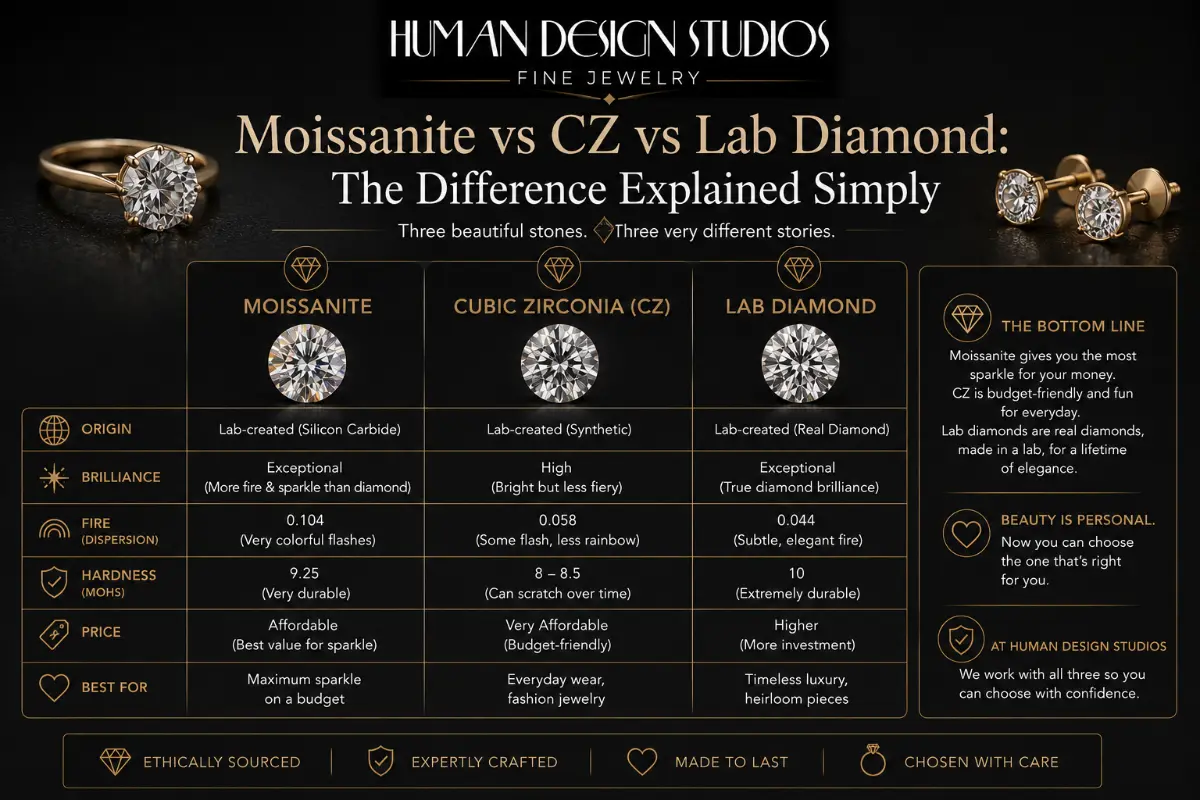
Cubic Zirconia (CZ) is zirconium dioxide. It is entirely lab-made, developed in the 1970s originally for industrial laser optics and later adopted by the jewelry industry as a low-cost diamond simulant. CZ has no natural occurrence and no gemological standing as a precious stone. It is a mass-produced, highly accessible material.
Moissanite is silicon carbide. It was first discovered in 1893 by French chemist Henri Moissan inside a meteorite crater in Arizona. He believed he had found diamonds. He had not. Natural moissanite is extraordinarily rare, so every moissanite used in jewelry today is a lab-created gemstone grown under controlled conditions. It is a genuine, certified gemstone with its own optical identity. Explore our full Moissanite Collection to see what it looks like in fine settings.
Lab-grown diamond is carbon. Chemically, atomically, and optically, it is identical to a natural diamond pulled from the earth. The only difference is where it was formed: in a controlled laboratory environment using Chemical Vapor Deposition (CVD) or High Pressure High Temperature (HPHT) methods instead of deep underground over millions of years. A lab diamond is not a diamond simulant. It is a real diamond. View our Laboratory Diamonds Collection to see the range we work with.
Understanding this is step one. These three stones are not a spectrum of the same thing at different price points. They are three distinct materials with different chemistry, different optical behavior, and different long-term performance.
Cubic Zirconia: Why It Is Not Fine Jewelry
Let’s handle CZ directly, because the jewelry industry often dances around this truth.
CZ is not fine jewelry. It is a fashion material, and there is nothing wrong with using it as one, as long as you understand what you are buying.
Here is what happens to CZ over time:
CZ scratches fast. It scores 8 to 8.5 on the Mohs hardness scale. Everyday materials including sand, dust, and quartz particles (which are everywhere) register at 7. Constant daily contact with these materials produces micro-scratches across the surface of a CZ stone within weeks to months. Once the surface scratches, light scatters unevenly. The sparkle becomes dull and lifeless.
CZ clouds. The crystal structure degrades with UV exposure, body oils, lotions, soap residue, and cleaning products. Within two to five years of daily wear, most CZ stones appear hazy, yellowed, or visibly dull. This is not a care issue. It is a material issue.
CZ is dense. CZ weighs approximately 1.7 times more than diamond for the same visual size. An experienced jeweler can detect this immediately by weight alone.
CZ has no certification. There is no gemological grading system for CZ quality because there is no meaningful quality tier. It is mass-produced commodity material.
Is CZ worthless? No. For travel jewelry, costume pieces, fashion accessories that will be rotated seasonally, or temporary placeholders during a custom design process, CZ is practical and cost-effective. But for an engagement ring, a daily wear piece, or any jewelry meant to last, CZ is the wrong material.
If you are looking for budget-conscious fine jewelry that genuinely lasts, start with our Essentials Collection, designed for everyday wear in solid 14k gold with gemstones that hold up to real life.
Moissanite: Composition, Origin, and Why 9.25 Mohs Changes Everything
Moissanite is not competing with CZ. It is competing with diamond, and winning on several metrics.
The silicon carbide gemstone structure gives moissanite properties that make it a legitimate fine jewelry choice:
Hardness of 9.25 on the Mohs scale. This places moissanite above rubies (9.0), sapphires (9.0), and every gemstone except diamond. In daily wear conditions, the 0.75 point gap between moissanite at 9.25 and diamond at 10 is not a practical disadvantage. It means moissanite will not scratch from everyday contact with any material a person normally encounters. Stones set in our solid 14k moissanite rings maintain their surface polish and brilliance for decades without degradation.
Refractive index of 2.65 to 2.69. This is the measurement of how much light bends when it enters the stone. Diamond sits at 2.42. Moissanite is higher, which means more light is captured, bent, and returned to the viewer’s eye.
Fire dispersion of 0.104. Diamond’s dispersion is 0.044. Moissanite’s dispersion is more than double. This is the direct cause of the intense rainbow fire that moissanite produces, the colored flashes that arc across a surface when the stone moves through light. Some buyers find this extraordinary. Some find it too intense. Both reactions are valid. What matters is that you see it in person before deciding.
Moissanite clarity is near-flawless by default. Because it is lab-created, moissanite is produced without the inclusions, blemishes, and imperfections that grade natural and even many lab diamonds. Every stone in our Moissanite Collection includes certification of authenticity.
Moissanite does not cloud. Unlike CZ, the silicon carbide structure is chemically stable. It does not react to UV light, body oils, or cleaning agents in a way that degrades optical performance. A well-set moissanite looks the same in year 20 as it did in year one. See our Care Guide for maintenance best practices.
For buyers who want the most visual impact per dollar spent, moissanite delivers more fire and brilliance than any natural diamond at any price. Browse our Moissanite Earrings, Moissanite Necklaces, and Pendants to see it across every jewelry category.
Lab Diamond: Why It Is Physically Identical to Natural Diamond
This is the point most lab diamond guides understate because they worry it makes the product seem less special.
A lab-grown diamond is not like a diamond. It is a diamond.
Same carbon structure. Same hardness of 10 on the Mohs scale. Same refractive index of 2.42. Same optical properties. Same density. The only meaningful differences are price and origin.
In 2026, a high-quality 1-carat lab-grown diamond costs between $900 and $2,500 depending on the cut, color, and clarity grade. The same stone mined from the earth costs between $4,500 and $8,000. The lab diamond is between 60 and 80 percent less expensive for an identical product.
Lab diamonds are graded by the same institutions (IGI, GIA) using the same 4Cs grading framework (cut, color, clarity, carat) as natural diamonds. When you purchase a lab-grown diamond at Human Design Studios, you receive a graded, certified stone with a full documentation trail.
The one honest limitation of lab diamonds: minimal resale value. Natural diamonds carry historical market value. Lab diamonds, like moissanite, are not investment vehicles. This is true across the industry. If your purchase is about wearing a beautiful, durable, ethically sourced stone in a piece of fine jewelry you will treasure, lab diamonds are an outstanding choice. If resale is the goal, a different conversation is needed.
Sparkle Test: Moissanite vs CZ vs Lab Diamond Under Real Light
This is the section every buyer actually wants. Here is the honest sparkle comparison by stone:
Property
CZ
Moissanite
Lab Diamond
Refractive Index
2.15 to 2.18
2.65 to 2.69
2.42
Fire Dispersion
0.060
0.104
0.044
Brilliance (White Flash)
High when new
Exceptional, stable
Exceptional, stable
Performance After 2 Years
Dull, clouded
Unchanged
Unchanged
Scintillation (Moving Flash)
Low after wear
Extremely high
High
What this actually looks like in real life:
CZ when brand new looks surprisingly good. Under soft indoor lighting, at a distance, it catches the eye. Put it next to a moissanite or a diamond though, and the difference in depth and sharpness is immediately visible even to untrained eyes. After two to six months of daily wear, CZ develops micro-scratches that scatter light unevenly. After one to two years, the surface haze is obvious.
Moissanite produces the most colored fire of any gemstone used in fine jewelry. Under sunlight, at events, in photographs, and under direct indoor lighting, it throws intense rainbow flashes that draw attention. The “disco ball” description is real. Whether that is exciting or excessive is personal preference, not a quality judgment.
Lab diamond produces the sparkle most people associate with fine jewelry: deep, controlled, white brilliance with sharp reflections and restrained fire. It does not overwhelm the room. It commands it quietly.
At our studio, we encourage every client to look at all three stones under multiple lighting conditions before committing. Our Custom Experience includes a stone selection consultation where this comparison happens in person.
Price-to-Quality Matrix: Which Stone Wins by Budget and Use Case
Here is the honest matrix every buyer should see before deciding:
Engagement rings, heirloom pieces, full diamond settings
$5,000 and above
Natural Diamond
Collector pieces, maximum prestige, investment context
The matrix is not a ranking of quality from bad to good. It is a guide to where each stone delivers the best value for its purpose.
A moissanite in a solid 14k yellow gold stacking ring at $350 is not a compromise. It is the right stone for that price point and use case. A lab diamond engagement ring at $2,200 in an artisan prong setting is not a budget choice. It is a smart allocation of fine jewelry spending.
All three stones are available in our studio’s custom design process. Our Custom Design page walks through how we work with clients to match stone, setting, metal, and budget into a single coherent piece.
Human Design Studios’ Recommendation for Everyday Fine Jewelry
Gabriella has set all three of these stones into solid 14k gold. Here is her direct recommendation, written with no sales agenda:
“For everyday fine jewelry worn daily and meant to last decades, I do not recommend CZ in any setting. The degradation timeline is not compatible with what fine jewelry should do. For my clients who want maximum visual impact at an accessible price point, moissanite in solid 14k gold is where I start every conversation.
For clients who specifically want a diamond, whether for tradition, identity, or the specific optical character of diamond sparkle, I direct them to lab-grown options first. The savings over natural diamonds are significant, the stone is identical, and the ethical profile is clean.
What I look for in every piece, regardless of stone, is a setting that serves the stone’s optical properties and a metal quality that matches the stone’s durability. There is no point setting a moissanite with a 9.25 hardness rating in gold-filled metal. The stone deserves solid gold. That is the standard we hold at Human Design Studios.”
Is moissanite a diamond simulant like CZ? No. Moissanite is a distinct gemstone with its own chemical composition (silicon carbide), its own optical properties, and its own gem certification. CZ is a diamond simulant with no gemological standing. Moissanite is a lab-created gemstone that happens to look similar to diamond while possessing different and in some ways superior optical qualities.
Can jewelers tell moissanite and lab diamonds apart without equipment? Trained gemologists using a moissanite tester (different from a standard diamond tester) can distinguish the two. Many diamond testers incorrectly identify moissanite as diamond because of moissanite’s high thermal conductivity. For buyers, this is not a concern. For jewelers setting stones, it matters for selecting the correct equipment.
How long does moissanite last compared to CZ? Moissanite is rated for lifetime durability with no optical degradation. CZ shows visible wear within one to two years of daily use and typically needs replacement within three to five years. For daily wear jewelry, moissanite and lab diamond are the only stones in this category worth serious consideration.
Does Human Design Studios set CZ in its pieces? No. All Human Design Studios pieces use genuine gemstones including moissanite, lab-grown diamonds, natural diamonds, and precious colored stones. Our Gemstones Category includes a full range of certified stones used in custom and ready-to-wear pieces.
Where can I see these stones in person before buying? Human Design Studios operates pop-up events in New York City (Chelsea Market area), Oahu Hawaii, and Nashville and Franklin Tennessee. Check our Stockists page for current event dates and retail locations. Online customers can contact us through our Contact page to schedule a virtual stone consultation before custom orders.
What warranty and repair coverage applies to moissanite and lab diamond pieces? All Human Design Studios jewelry is covered under our Repairs and Warranty program. Every piece includes a certificate of authenticity for the stones it contains. Our Shipping and Exchanges policy covers delivery and return details for online purchases.
Is there a size guide for rings and bracelets? Yes. Use our Find My Size tool before placing a ring or bracelet order online.
Can I see frequently asked questions about the studio and ordering process? Our full FAQ page covers ordering, custom design timelines, care, resizing, and more.
The Bottom Line: Moissanite vs CZ vs Lab Diamond in 2026
Here is the three-sentence answer every buyer actually needs:
CZ is a fashion material with a two to five year performance window. It belongs in accessories, not in fine jewelry meant to last.
Moissanite is a genuine, lab-created gemstone with exceptional durability, extraordinary fire, and a price point that makes solid gold settings accessible to almost any budget.
Lab diamond is a real diamond, grown above ground, at 60 to 80 percent less than earth-mined equivalent. It delivers the traditional diamond identity with an ethical sourcing profile and no visual compromise.
At Human Design Studios, all three pathways are available. What we bring to the decision is bench experience, honest guidance, and craftsmanship in solid 14k gold that elevates whichever stone you choose into something genuinely worth keeping.
Human Design Studios Fine Jewelry serves clients in New York City, Oahu Hawaii, Nashville and Franklin Tennessee, and ships worldwide. All moissanite and lab diamond pieces include certificates of authenticity. Custom orders are available with personal design consultations. Visit our Blog for more guides on choosing fine jewelry that lasts.