Most moissanite vs diamond comparisons are written by people who have never held either stone under a loupe.
This one is not.
At Human Design Studios Fine Jewelry, our founder Gabriella has spent years setting moissanite, lab-grown diamonds, and natural diamonds into solid 14k gold. She has worked with clients from New York’s Chelsea Market to Hawaii to Franklin, Tennessee. She has seen what each stone does in an artisan setting, under real light, on real people, in real life.
What you are about to read is her honest 2026 breakdown not a manufacturer’s pitch, not a ranking algorithm’s summary. This is bench-level clarity.
What Is Moissanite? The Silicon Carbide Gemstone With a Meteorite Origin
Moissanite starts with a story that no diamond can match.
In 1893, Nobel Prize-winning chemist Henri Moissan discovered microscopic crystals inside a meteorite crater in Arizona. He initially believed he had found diamonds. He had not. The crystals were silicon carbide — a compound so rare in nature that virtually all moissanite available today is lab-created.
That origin matters. The silicon carbide gemstone structure is fundamentally different from diamond’s pure carbon lattice. This difference in atomic arrangement is not a weakness. It is the precise reason moissanite behaves differently under light — and for many buyers, it behaves better.
Modern lab-created moissanite is grown under controlled conditions, producing stones of exceptional consistency. There are no mining operations, no conflict zones, no supply chain opacity. Every stone in our Moissanite Collection arrives with full provenance and certification of authenticity.
Moissanite vs Diamond 2026: The Side-by-Side Breakdown
Let’s put the numbers on the table. This is the comparison every buyer should see before making any decision.
Property
Moissanite
Natural Diamond
Lab Diamond
Hardness (Mohs)
9.25
10
10
Refractive Index
2.65 – 2.69
2.42
2.42
Fire Dispersion
0.104
0.044
0.044
Brilliance (White Light)
Very High
High
High
Clarity
Near-flawless (lab precision)
Varies (VVS to I)
Near-flawless
Origin
Lab-created (silicon carbide)
Earth-mined
Lab-created (carbon)
1-Carat Price (2026)
$300 – $600
$4,500 – $8,000
$900 – $2,500
Ethical Sourcing
Yes
Varies
Yes
Lifetime Durability
Excellent
Excellent
Excellent
What this table actually tells you:
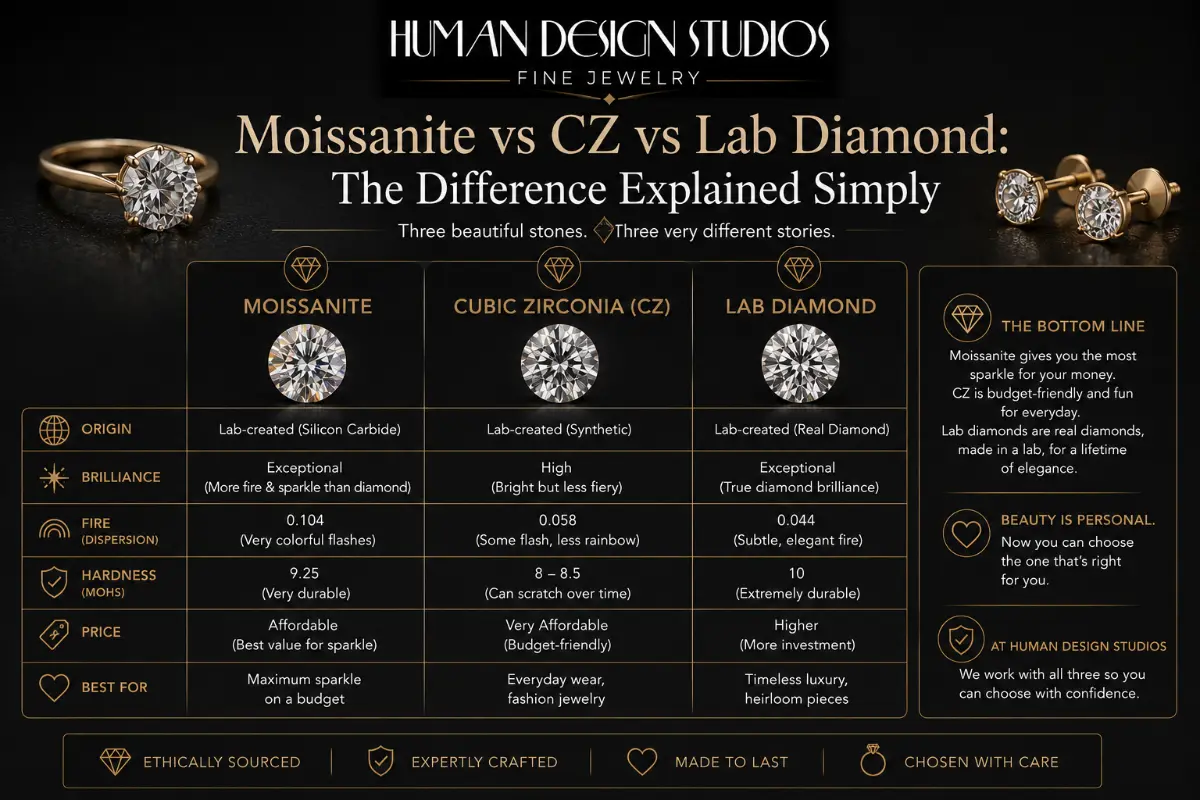
Moissanite has a higher refractive index (2.65-2.69) than any diamond (2.42). That single number explains why moissanite produces approximately 2.4 times more fire dispersion — the rainbow flash that makes a stone pop when it catches light. Moissanite brilliance, the white light reflected back to your eye, is also measurably higher.
Hardness is often used to argue against moissanite. Do not let that argument land unchallenged. At 9.25 on the Mohs scale, moissanite is harder than rubies, sapphires, and every gemstone except diamond. In a decade of daily wear, the 0.75 point difference between moissanite and diamond means nothing to any jewelry wearer on earth.
The Real-World Price Gap: What $4,500 in Savings Actually Means
Let us be direct about money, because the jewelry industry rarely is.
In 2026, a high-quality 1-carat moissanite costs between $300 and $600. A comparable 1-carat natural diamond costs between $4,500 and $8,000. For a 1.5-carat center stone, couples choosing moissanite save an average of $4,500 compared to a natural diamond of equivalent visual quality.
That is not a rounding error.
$4,500 is a meaningful portion of a home down payment. It is a honeymoon. It is a year of savings invested. It is the budget for a custom artisan setting that elevates the stone into something genuinely heirloom-worthy — which is exactly what our Custom Design service exists to do.
Choosing moissanite is not choosing less. It is choosing to redirect luxury. You get a stone with superior fire dispersion, near-identical visual impact, and the difference in dollars goes somewhere that actually shapes your life.
This is why moissanite is the fastest-growing diamond alternative in the fine jewelry market in 2026. The global moissanite market is projected to exceed $100 million this year. Buyers are not buying moissanite because they cannot afford a diamond. They are buying it because the math is undeniable.
Moissanite in Artisan Settings: How It Performs in Solid 14k Gold
Here is what most comparison guides will never tell you: the stone only tells half the story. The setting writes the other half.
Moissanite performs extraordinarily well in solid 14k gold — and we have years of real-world data to back this.
When a moissanite is set in 14k yellow gold, the warm tonal contrast amplifies the stone’s fire dispersion, pulling more amber and gold into the spectrum of color it throws. In 14k white gold, the cool backdrop maximizes the white brilliance, making the stone appear larger and crisper. In 14k rose gold, the blush tones create a romantic warmth that no mined diamond in the same price range can replicate.
One thing our studio does that mass-market retailers cannot: we hand-select stones for each custom order. If you want to select your own moissanite, our Custom Experience lets you do exactly that. You see the stone before it goes into your setting. That level of care is how artisan jewelry should work.
Lab Diamond vs Moissanite: The Third Option Explained
Every buyer eventually asks: what about lab diamonds?
A lab-grown diamond is a real diamond. It shares the exact carbon structure, hardness, and optical properties of a mined diamond — because it is created by replicating the pressure and heat of Earth’s mantle in a controlled environment. It is not a simulant. It is not moissanite. It is pure carbon, grown above ground.
Here is how the three options compare in 2026:
Natural Diamond: Maximum cultural prestige, highest price ($4,500 to $8,000+ per carat), moderate ethical variance depending on sourcing, slight edge in resale value. Best for buyers where tradition and symbol carry the most weight.
Lab-Grown Diamond: Ethically unimpeachable, identical optically and chemically to natural diamonds, significantly lower price ($900 to $2,500 per carat), minimal resale value. Best for buyers who want the diamond identity without the mining footprint.
Moissanite: Lab-created silicon carbide gemstone, 2.4 times more fire dispersion than diamond, near-identical durability, lowest price ($300 to $600 per carat), near-zero resale value. Best for buyers who want maximum visual impact and maximum value — and who are not attached to the word “diamond.”
Sparkle Comparison: What Fire Dispersion Actually Looks Like
This section is for buyers who want the optical science without the jargon overload.
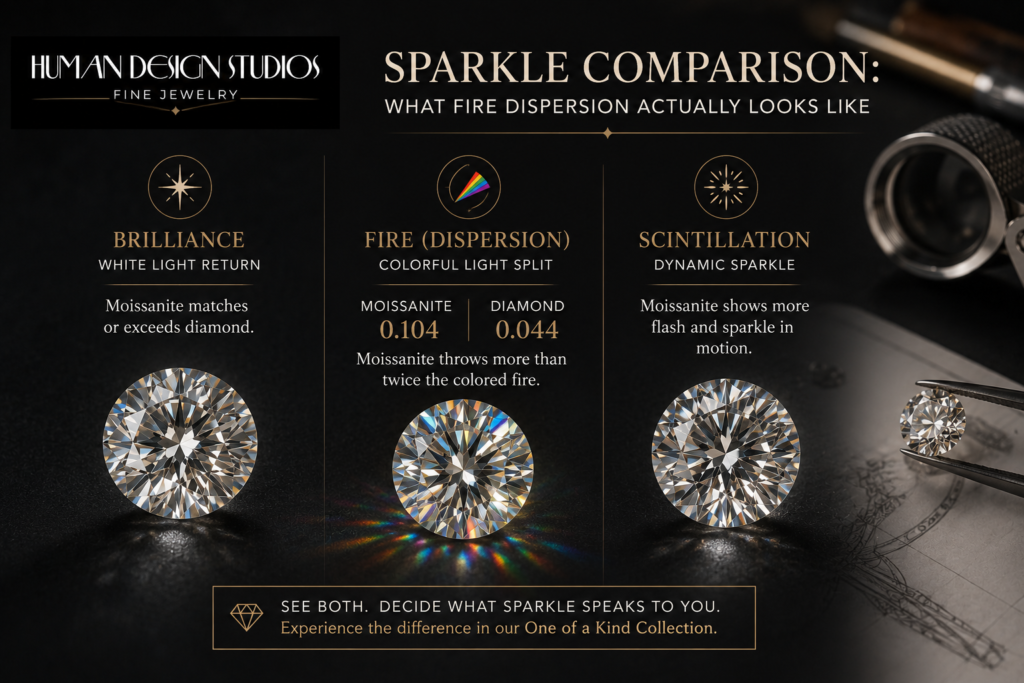
Brilliance is white light. When light enters a stone and reflects back, the white return is brilliance. Diamonds are renowned for it. Moissanite matches or exceeds it.
Fire is the color. When white light splits into spectral colors — the rainbow flash a stone throws across a table or a hand — that is fire dispersion. Moissanite’s dispersion value is 0.104. Diamond’s is 0.044. Moissanite throws more than twice the colored fire of any diamond at any price point.
Scintillation is the flash when the stone moves. This is where the sparkle comparison most dramatically favors moissanite. Under indoor lighting, at events, in photographs, the moissanite sparkle is unmistakably more active and colorful.
Is that right for everyone? No. Some buyers prefer diamond’s subtler, more restrained brilliance. Some find moissanite’s fire “disco-ball” intense. This is a genuine aesthetic preference, not a quality difference. At Human Design Studios, we encourage every client to see both stones before deciding.
Our One of a Kind Collection includes unique pieces where you can experience the difference in person during a custom consultation.
What Gabriella Recommends: The Studio Perspective
Gabriella has set hundreds of moissanite stones into fine jewelry. Here is what she tells clients directly.
“If you want the largest, most visually striking stone for your budget — without compromise on metal quality or craftsmanship — moissanite in solid 14k gold is where I start every conversation. The fire is extraordinary. In the right setting, in the right light, it is breathtaking.
If cultural tradition matters deeply to you — if you want to say ‘this is a diamond’ and mean it in the geological sense — I would guide you toward a lab-grown diamond. Same optical result, ethical sourcing, and the word ‘diamond’ is accurate.
What I do not recommend is buying a mined diamond at retail without understanding the full picture. You are paying 80 to 90 percent more for a stone that, visually, most people cannot distinguish from a lab-grown alternative. The budget difference should go into the setting, the craftsmanship, or your life together.”
That is not a sales pitch. That is fifteen years of bench experience, distilled.
You can book a design consultation with Gabriella through our Custom Design page or reach out via our Contact page. If you are in New York, Franklin, Tennessee, Hawaii, or attending any of our pop-up events, you can experience the stones in person.
FAQ: Moissanite vs Diamond 2026
Can you tell the difference between moissanite and diamond with the naked eye? In most real-world settings — photos, across a table, at events — the answer is no. Trained gemologists using specialized testers can detect the difference. A dinner guest cannot.
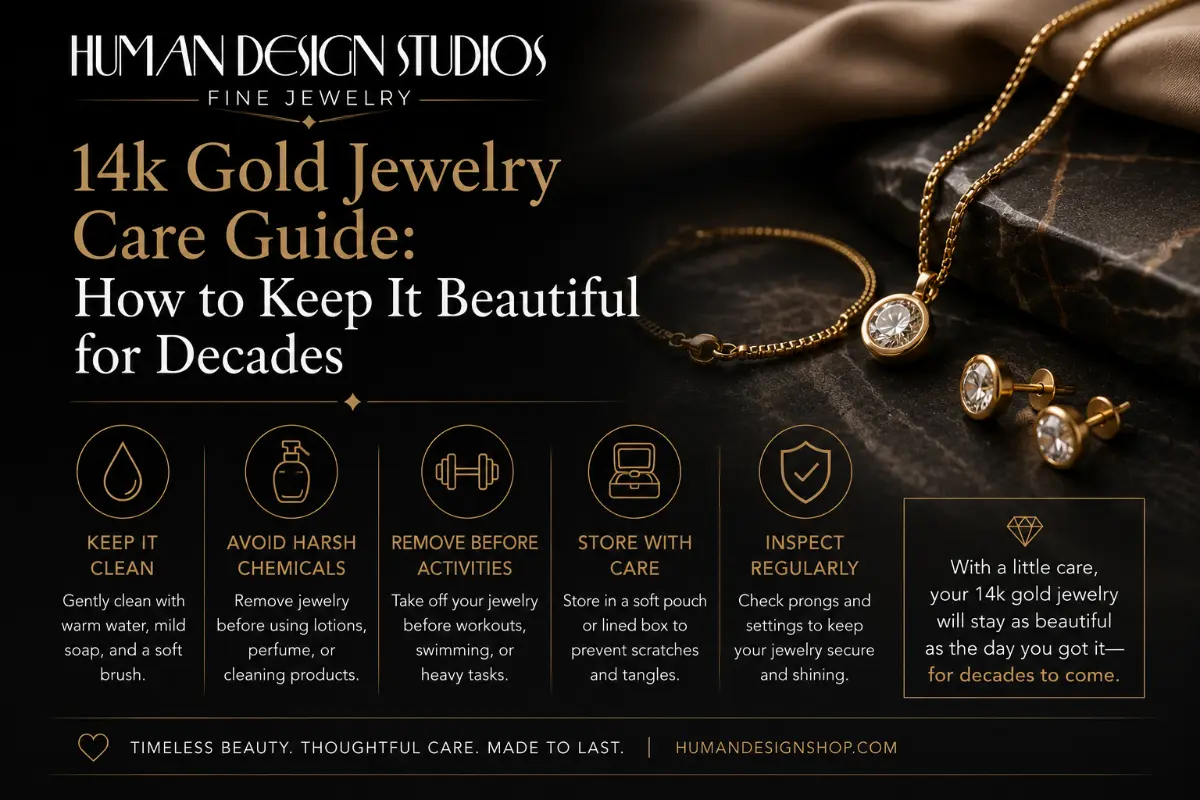
Does moissanite cloud or scratch over time? No. Unlike cubic zirconia or glass, moissanite is a genuine, lab-created gemstone with a Mohs hardness of 9.25. It will not cloud, scratch in daily wear, or lose its optical properties. Many of our clients have worn Gabriella-set pieces for years without any degradation. Read our Care Guide for maintenance tips.
Is moissanite a fake diamond? No. Moissanite is its own distinct gemstone — a lab-created silicon carbide stone. It is no more “fake” than a sapphire or emerald. It is not diamond, but it is genuinely precious, genuinely durable, and genuinely beautiful.
What metals work best with moissanite? Solid 14k gold in yellow, white, and rose are our preferred metals at Human Design Studios. All three enhance different aspects of moissanite’s optical profile. We do not recommend gold-filled or plated options for moissanite settings — the stone deserves a metal that matches its quality. Explore our Gold-Filled Collection and solid gold options side by side.
Does moissanite have resale value? Minimal. This is the honest answer, and it applies to lab-grown diamonds as well. If resale value is a priority, natural diamonds retain more market value over time. If your priority is beauty, durability, and budget intelligence, moissanite wins without contest.
Can I get moissanite in a custom design? Yes — and this is where Human Design Studios excels. Our Custom Experience walks you through stone selection, setting design, and metal choice. We can match existing pieces, design from a sketch, or replicate a style with your own stone at competitive pricing. View our FAQ page for more on the process.
Our Moissanite Collection at Human Design Studios
The Human Design Studios Moissanite Collection spans 112 pieces — earrings, rings, necklaces, bracelets, pendants, and anklets — all crafted in solid 14k gold in yellow, white, and rose options.
Every piece is designed by Gabriella and handcrafted with the same standards applied to our natural and lab-grown diamond jewelry. Certifications of authenticity are included. Our Repairs and Warranty program covers lifetime service on every piece we make.
New to fine jewelry? Start with our Essentials Collection — designed for everyday wear with the same moissanite brilliance. Ready to make a statement? Browse our Wedding Day Collection for bridal and anniversary pieces built to last generations.
The moissanite vs diamond debate ends differently in 2026 than it did even five years ago.
The technology is better. The stones are more refined. The cultural acceptance is real. And the price gap has not closed — it has widened, because diamond prices have risen while moissanite has remained accessible.
What this means for a buyer in 2026 is simple: you can have a 2-carat moissanite in a custom solid 14k gold artisan setting for less than the cost of a 0.5-carat natural diamond of comparable quality. You can see both in person, compare them under loupe and natural light, and make the call that is right for your life.
At Human Design Studios, we will not push you toward any stone. We will show you both, tell you the truth about both, and set whichever you choose with the same level of craftsmanship and care. See us on Instagram