A 14k gold jewelry care guide should be the first thing you read after buying a solid gold piece, not the last thing you search after something goes wrong. The truth is that most jewelry damage is completely preventable. Tarnish, scratches, loosened stones, and dulled finishes are not inevitable consequences of everyday wear. They are almost always the result of small habits that nobody told you to avoid.
This guide covers everything: why 14k gold is the smartest metal choice for everyday fine jewelry, exactly how to clean it at home without risking damage, how to store it correctly, when to take it off, and when to bring it to a professional. If you own pieces from the Human Design Studios Fine Jewelry collection, this guide was written specifically with your investment in mind.
Before diving into care, it helps to understand what you are actually working with, because the composition of 14k gold directly explains how to protect it.
Pure gold, also known as 24k gold, is 99.9% gold. It is breathtakingly rich in color but far too soft for daily wear. It bends, scratches, and deforms under normal activity. Jewelers have long known this, which is why fine jewelry is almost never made in pure gold.
14k gold is composed of 58.3% pure gold alloyed with metals like copper, silver, and zinc. That combination gives it meaningful hardness and resilience while retaining the warm, recognizable glow of gold. It sits in the sweet spot between beauty and durability that makes it the most popular gold karat in the United States market for everyday pieces.
Because 14k gold contains alloy metals alongside the gold, it behaves slightly differently than higher-karat golds. The copper and silver components can react with chemicals, moisture, and skin oils over time, which is why a solid gold jewelry care routine matters. The gold itself never corrodes or tarnishes. It is the alloy metals that respond to environmental exposure. Understanding that distinction tells you exactly what your care routine is protecting against.
At Human Design Studios, every piece in our collection, from rings to necklaces to earrings, is crafted from solid 14k gold. Not gold-filled. Not gold-plated. Solid gold all the way through, which means your piece will still be solid gold in 30 years.
Daily Habits That Protect Your Gold Jewelry
Fine jewelry maintenance begins with what you do every single day, not just on cleaning day. These small, consistent habits are what separate jewelry that looks stunning after a decade from jewelry that looks tired after a year.
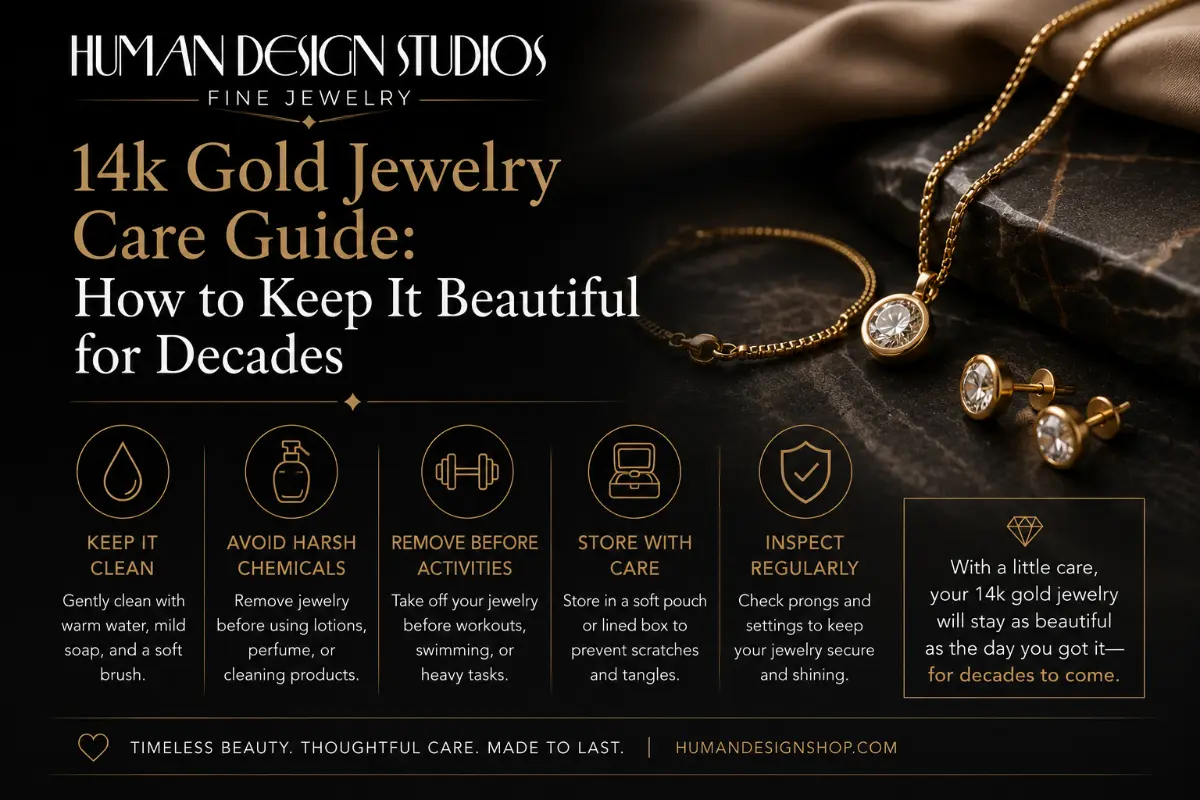
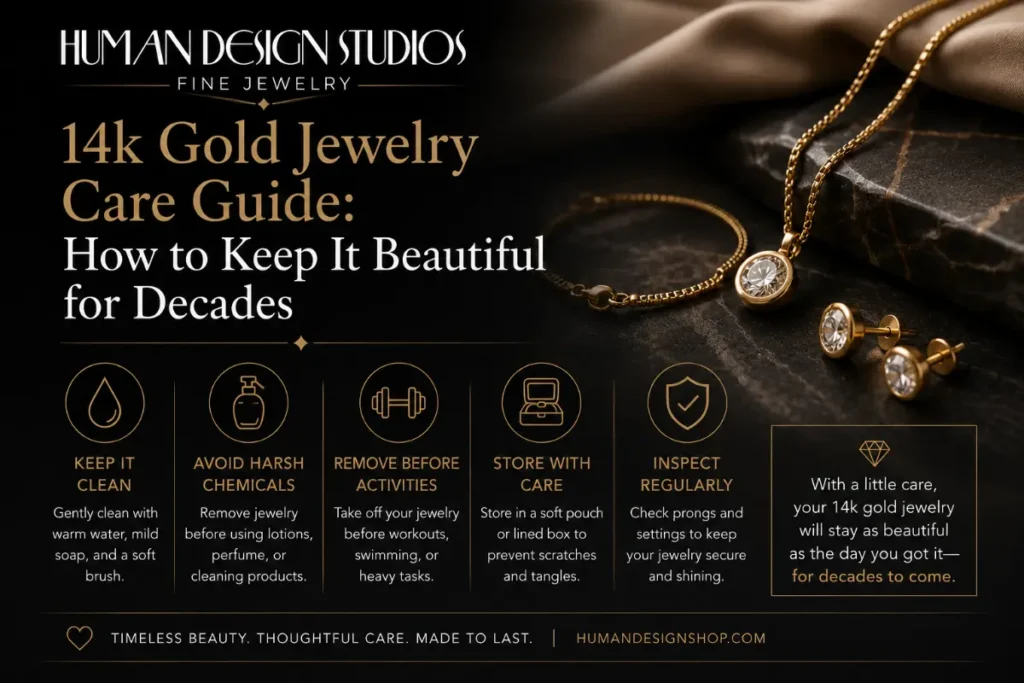
Apply everything before putting on your jewelry. Perfume, lotion, sunscreen, hairspray, and dry shampoo all contain chemicals that can interact with the alloy metals in 14k gold, building up a film that dulls the surface over time. The rule is simple: get dressed, then put your jewelry on last. Remove it first when you get home.
Wipe your pieces down after wearing them. Body oils, sweat, and cosmetic residue accumulate on gold surfaces daily. A quick, gentle wipe with a soft lint-free cloth after each wear takes about 10 seconds and prevents significant buildup. Keep a polishing cloth in your jewelry storage area so it becomes automatic.
Keep gold away from chlorine. Chlorine is one of the most damaging substances for 14k gold alloy. It reacts with the copper content in the alloy, weakening the metal’s structure over time and dulling its surface. Pool water, hot tubs, and even some household cleaning products contain chlorine. This is not an exaggeration for caution’s sake. It is chemistry. The damage from repeated chlorine exposure is cumulative and permanent.
Keep gold away from saltwater. Ocean water and the combination of salt, minerals, and sand creates an abrasive, corrosive environment for fine jewelry. Salt can accelerate oxidation of the alloy metals, and sand particles are abrasive enough to micro-scratch polished gold surfaces.
Remove jewelry before using any cleaning products. Bleach, ammonia-based cleaners, and abrasive scrubs can all affect 14k gold. Even seemingly gentle products like hand sanitizer, which contains high-percentage alcohol, can dull the finish of certain gold pieces over repeated exposure.
How to Clean 14k Gold Jewelry at Home: The Safe Method and What to Avoid
Cleaning your 14k gold jewelry at home is straightforward when you use the right approach. The good news: the safest and most effective method uses materials you already have at home.
The Correct At-Home Cleaning Method
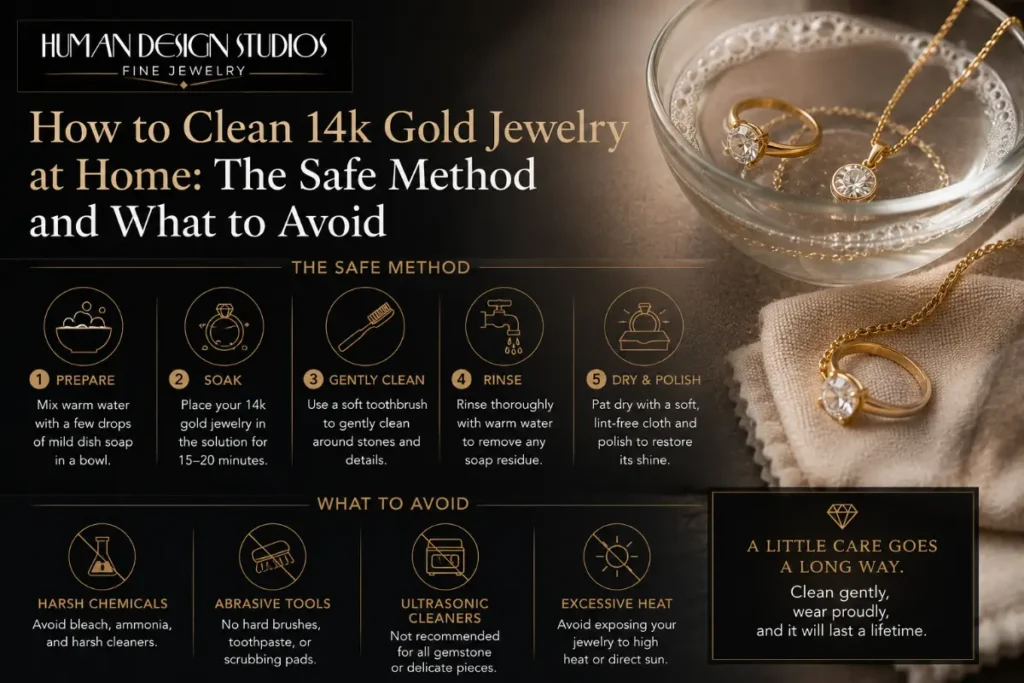
You will need warm water, a small bowl, a few drops of mild dish soap (fragrance-free and dye-free is ideal), and a very soft-bristled brush such as a baby toothbrush or a dedicated jewelry brush.
Fill the bowl with lukewarm water. Water that is too hot can loosen adhesives in stone settings. Add two to three drops of mild dish soap and stir gently. Place your gold piece in the solution and let it soak for 10 to 15 minutes. This loosens oils, dirt, and residue from crevices and settings.
After soaking, use the soft brush to gently scrub the piece, paying attention to prong settings, chain links, and any textured surfaces where buildup tends to concentrate. Work gently without pressing hard. Rinse the piece thoroughly under lukewarm running water. Hold it over a bowl or use a stopped drain, never the open drain, to avoid any risk of loss.
Pat the piece completely dry with a lint-free soft cloth. Do not let it air-dry with water droplets sitting on the surface, as this can leave mineral spots on polished gold. Allow it to finish air-drying fully before placing it in storage.
For pieces set with moissanite, lab diamonds, or natural diamonds, this method is safe and effective. Both moissanite and diamond have a Mohs hardness rating that makes them highly resistant to scratching during gentle cleaning.
For pieces set with birthstones or softer gemstones like opal, turquoise, or pearl, use extra caution. Some softer stones can be damaged by prolonged soaking. A light wipe with a damp cloth is safer than full immersion for those pieces.
What to Avoid Completely
Toothpaste is abrasive and will micro-scratch the surface of gold over time. Avoid it entirely. Baking soda is similarly abrasive despite being a popular DIY suggestion. Avoid it. Vinegar and lemon juice are acids that can affect alloy metals and dull certain finishes. Ammonia-based solutions should never be used on gold set with porous stones. Ultrasonic cleaners are powerful tools in professional hands but can loosen prong settings if used incorrectly at home, particularly on older pieces or pieces with pavé-set stones.
When in doubt, bring your piece to a professional. Our Repairs and Warranty service exists precisely for this.
How to Store Gold Jewelry: Airtight Bags, Separate Compartments, and Smart Systems
Jewelry storage is one of the most overlooked aspects of fine jewelry maintenance, and it is responsible for a significant amount of preventable damage.
Store pieces separately. Even solid gold scratches against other gold. Diamonds and moissanite can scratch gold surfaces due to their superior hardness. A tangle of chains in a single drawer means scratches, knots, and stress on delicate clasps every single time you reach in. Every piece deserves its own space.
Use soft-lined compartments or individual pouches. A jewelry organizer with separate fabric-lined compartments is the minimum standard. Individual velvet or microfiber pouches work equally well and are ideal for travel. The goal is preventing any two pieces from touching each other.
Airtight bags for extended storage. If you are storing a piece for a season or longer, place it in a small zip-lock or resealable anti-tarnish bag before putting it in your jewelry box. Minimizing air exposure slows the natural oxidation process that affects alloy metals over long periods.
Keep jewelry away from humidity. Bathrooms are convenient but terrible storage locations for fine jewelry. Steam, moisture, and temperature fluctuation accelerate tarnish on alloy metals. Store your collection in a bedroom, ideally in a cool, dry place away from direct sunlight.
Necklace storage deserves specific attention. Hanging necklaces individually on hooks prevents tangling, which is both frustrating to deal with and potentially damaging to delicate chain links. Our necklaces and anklets should always be stored unclasped or hanging, never coiled loosely in a pile.
If you received a Human Design Studios piece in our branded packaging, that pouch or box is an appropriate short-term storage option. For long-term storage, upgrade to a dedicated jewelry organizer.
When to Take Your Jewelry Off: Pool, Gym, Sleep, and More
Solid gold is durable, but there are specific situations where removing your jewelry is genuinely the right call.
Swimming pools and hot tubs. Take your jewelry off every single time. Chlorine chemically degrades the alloy metals in 14k gold over repeated exposure. Hot tubs compound the problem with both chlorine and high heat. This applies to pieces from our entire collection, including the Threadless Collection, Heritage Collection, and Essentials Collection.
The gym and high-intensity activity. Heavy lifting, grip-intensive exercises, and contact sports all create conditions that can bend, scratch, or stress fine jewelry. Rings are particularly vulnerable during weight training, as the pressure of a barbell can deform the band over time. Remove rings and bracelets before any workout that involves gripping equipment.
Sleeping. This is a nuanced one. Fine jewelry designed for continuous wear, such as threadless studs or smooth hoops in helix placements, is generally safe to sleep in. However, chains, pendants, and rings with protruding stone settings can catch on pillowcases, bend, or create pressure points during sleep that accumulate into structural stress. When in doubt, take it off.
Showering. An occasional shower with your gold jewelry is not catastrophic. Daily showering while wearing jewelry does allow soap and product buildup to accumulate in settings and chain links faster than it would otherwise. If you shower with your jewelry regularly, increase the frequency of your at-home cleanings.
Cooking. This is surprisingly overlooked. Dough, raw proteins, and food residue work their way into ring settings and chain links easily. Cleaning products used in food preparation can also affect gold alloy. Remove rings, in particular, before cooking.
Signs Your Jewelry Needs Professional Cleaning or Repair
Your at-home routine handles regular maintenance. But there are signs that tell you it is time to bring a piece to a professional jeweler, and recognizing them early prevents small problems from becoming expensive ones.
Persistent dullness that does not respond to cleaning. If your piece looks dull even immediately after a home cleaning, there may be a buildup that requires ultrasonic or steam cleaning to fully dislodge. This is common in pieces with intricate settings or textured surfaces.
A loose stone. If you hear a slight rattle or feel a stone shift when you touch it, do not wait. A loose prong or bezel setting will eventually lead to a lost stone. A professional jeweler can re-tighten the setting before the stone is gone. This applies to all stone-set pieces in our collection, from moissanite tops to birthstone rings.
A bent prong. Prongs hold your stones in place. A bent or broken prong is both a structural failure and a cosmetic one. Do not try to bend it back yourself. Take it to a professional.
A broken or stiff clasp. Clasps on necklaces and bracelets experience the most mechanical stress of any component. A clasp that does not close securely is a piece that is going to be lost. A stiff clasp is annoying now and broken soon.
A thinning band. Rings worn daily experience steady metal loss from friction. Over years, the inside base of a ring shank can thin to the point where it needs professional re-shanking to restore its integrity.
Discoloration that cleaning does not fix. Significant discoloration, particularly in the alloy metals, may indicate chemical damage. A jeweler can assess whether polishing will restore the piece or whether additional work is needed.
If your Human Design Studios piece needs attention, our Repairs and Warranty page outlines our service guarantee. Do not let small issues sit.
Human Design Studios Care Guarantee and Repair Services
Human Design Studios is not a faceless online retailer. Every piece we create is handcrafted with intention, and we stand behind it with a real service commitment.
Our care philosophy extends beyond the point of sale. Every solid 14k gold piece from our shop is built to last decades when properly cared for. We provide a Care Guide directly on our site, and our FAQ page addresses common questions about maintenance, material safety, and everyday wear.
When you need professional service, our Repairs and Warranty service is your direct line. We handle prong re-tipping, clasp replacement, ring re-shanking, stone re-setting, and professional cleaning for pieces in our collection.
Not sure whether your piece needs repair or just a deep clean? Use our Contact page to reach our team directly. We would rather you ask than risk a preventable loss.
For customers who want to be certain about sizing before purchasing, our Find My Size guide covers ring sizing, bracelet measurement, and chain length reference. A properly sized piece is also a better-fitting piece, and fit reduces the mechanical stress that leads to damage over time.
If you are considering a completely bespoke piece, our Custom Design experience allows you to build something from the ground up with materials and proportions chosen specifically for how you live and wear jewelry.
We also do pop-up events and trunk shows across the United States, where you can see pieces in person, ask care questions directly, and explore the full collection. Check our Stockists page for upcoming locations.
Quick-Reference 14k Gold Jewelry Care Checklist
Daily: Put jewelry on last, after all products. Wipe down with a soft cloth after wearing. Store each piece separately.
Weekly: Inspect clasps, prongs, and stone settings for any movement or looseness.
Monthly: Full at-home cleaning using the warm water and mild soap method.
Every 1 to 2 years: Professional cleaning and inspection. Book via our Repairs and Warranty page.
Always remove jewelry for: Pools, hot tubs, ocean swimming, gym workouts with equipment, household cleaning, cooking with raw ingredients.
Frequently Asked Questions About 14k Gold Jewelry Care
Does 14k gold tarnish? Solid 14k gold does not tarnish the way silver does. However, the alloy metals in 14k gold can develop a slight surface dulling over time when exposed to chemicals, sweat, and cosmetics. Regular cleaning and correct storage prevent this almost entirely.
Can I shower with 14k gold jewelry on? Occasional showering will not damage solid 14k gold. Daily showering with soap and product exposure does accelerate buildup in settings. If you shower with your jewelry regularly, clean pieces more frequently and avoid leaving them in steamy bathrooms for storage.
How often should I clean my 14k gold jewelry? A thorough at-home cleaning once a month is a solid baseline for pieces worn regularly. Pieces worn daily, particularly rings and bracelets, benefit from a quick wipe-down after every wear.
Is it safe to clean 14k gold with toothpaste? No. Toothpaste contains abrasive particles designed to clean tooth enamel. Those same particles will micro-scratch the polished surface of gold over time. Use mild dish soap and water instead.
Can I use an ultrasonic cleaner at home? Ultrasonic cleaners work by vibration and can loosen prong-set stones, particularly on older pieces or those with hairline metal fatigue. Professional jewelers use them with expertise and proper settings. At-home use without that knowledge introduces risk. Stick to the soap-and-water method unless directed otherwise by our team.
The Bottom Line on 14k Gold Jewelry Care guide
A 14k gold jewelry care routine does not need to be complicated or time-consuming. Clean monthly. Wipe daily. Store separately. Know when to take it off. Watch for signs that a professional needs to look at it. That is the entire framework, and it costs almost nothing to implement.
The payoff is real. Solid 14k gold that is properly cared for does not just maintain its beauty. It appreciates in meaning and monetary value over time. The rings, earrings, necklaces, and bracelets in the Human Design Studios collection are not pieces you replace every few years. They are pieces you pass down.